
Why would a hacker care about my small business? (The 2026 Reality)
If you run a start-up, scale-up, a school, or an NGO, your to-do list is already way too long. You likely think: Why would a sophisticated cybercriminal spend days trying to crack my 10-person team (or even smaller) when they could go after a global bank?
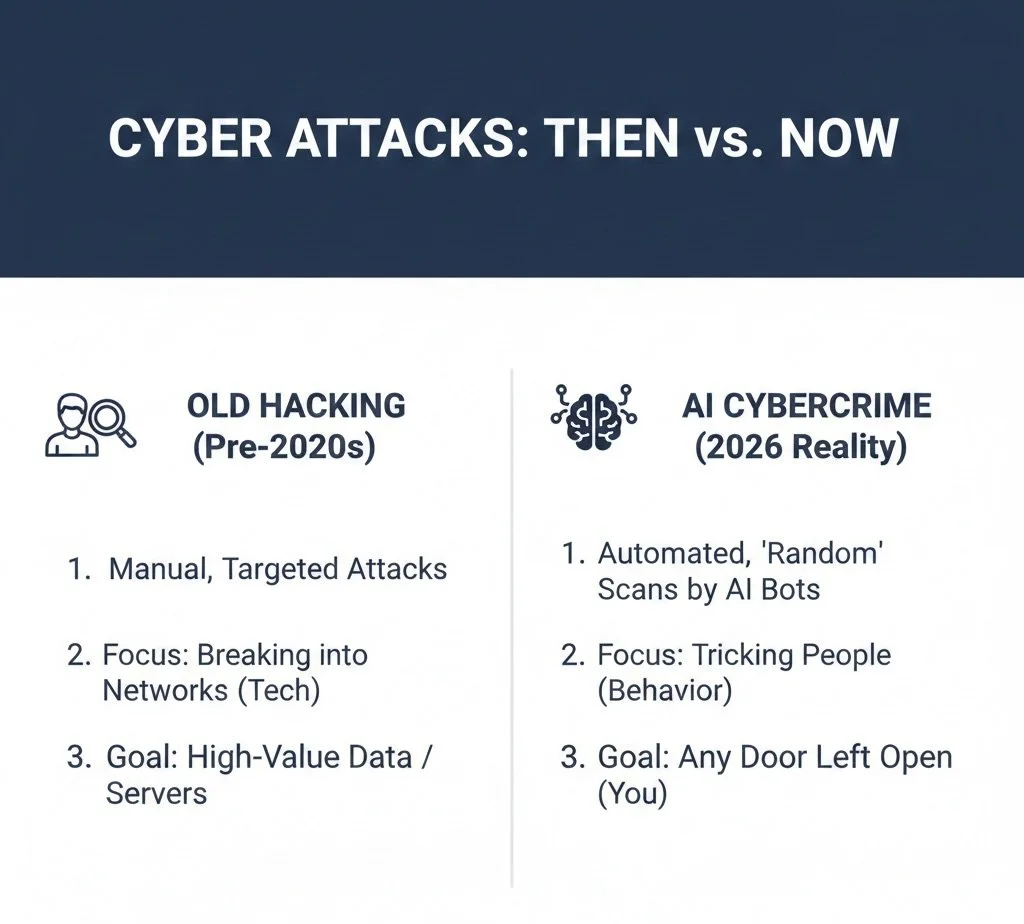
Here is the truth for 2026: Hackers aren't "choosing" you. Their software is. Let’s clarify how modern cybercrime really works and why being "small" can actually make you a more attractive target.
Imagine a burglar walking down a street. In the old days, they’d pick one house, watch it for days, and plan a break-in. They were looking for a high-value safe. Today’s cybercriminals don’t do that. Instead, they’ve released millions of 'Digital Robots' that walk down every single street in the world, 24/7. But they aren't looking for a safe; they are rattling the door handles of your employees' digital doors and seeing if someone opens.
The 2026 Shift: Hackers know that in small organizations, everyone wears five different hats. This is likely why small businesses are 350% more likely to be targeted* by social engineering attacks than those at larger firms. Cybercriminals now use Agentic AI which are smart bots that don't just scan code, they 'scan' people. These bots send thousands of personalized emails, LinkedIn messages, and even voice notes in seconds.
They aren't looking for a 'weak server.' They are looking for:
A busy employee who clicks 'Allow' on a weird pop-up just to get a video to play.
A helpful assistant or intern who replies to a 'urgent' WhatsApp from a fake director.
A startup founder who is so tired they don't notice the 'Login' page they just used looks slightly off.
At Lumensafe, we don't sell software or firewalls. We focus on the Human Firewall.
Here is why your team’s awareness is more important than any software you could buy:
Reason 1: You are the "Low-Hanging Fruit”
Threat actors recognize that small-business employees are often spread thin across multiple roles, creating 'attention gaps' that are easy to exploit. When you are busy, you are distracted. A distracted person is 3x more likely to miss a red flag in an "Urgent Invoice" email or a fake "WhatsApp from the Boss.” The cybercriminals don't care who you are; they only care if you are distracted enough to let them in. They wait for the moment of 'Decision Fatigue.' In fact, a joint study from Stanford University and Tessian found that nearly half of all employees who fell for a scam cited distraction as the primary reason. In a small, fast-moving team, distraction isn't a flaw, it's the daily reality.
Reason 2: Your Trust is Your Weakness
In a small team, you trust each other. You don't have a 50-page protocol for verifying a payment. Criminals use this "small-team culture" against you, pretending to be a colleague in a hurry because they know you’ll want to help them out. The FBI’s Internet Crime Report highlights that Business Email Compromise (where a criminal simply 'asks' for a payment by pretending to be someone you trust) is now a multi-billion dollar industry. They aren't looking for a technical backdoor; they are looking for that one 'un-bureaucratic' moment where a 5,000€ transfer happens without a second thought.
Reason 3: The "Supply Chain" Backdoor
Do you do work for a larger company? Or do you have a partnership with a city council? Hackers might target you just to get into their system. By using your "small" (and often less-guarded) email account, they can send a "trusted" message to a bigger target. On top of all that, believe it or not, your agility puts you at risk! Large companies are slow and bureaucratic. Small companies are fast and trust-based. Hackers monetize that speed.
I’m not suggesting you become slow and bureaucratic. In 2026, agility is your competitive advantage. But for that speed to be sustainable, your team needs a new set of 'Intuitive Guardrails.' At Lumensafe, we don't build 50-page manuals. We build these four agile skills into your team’s daily rhythm:
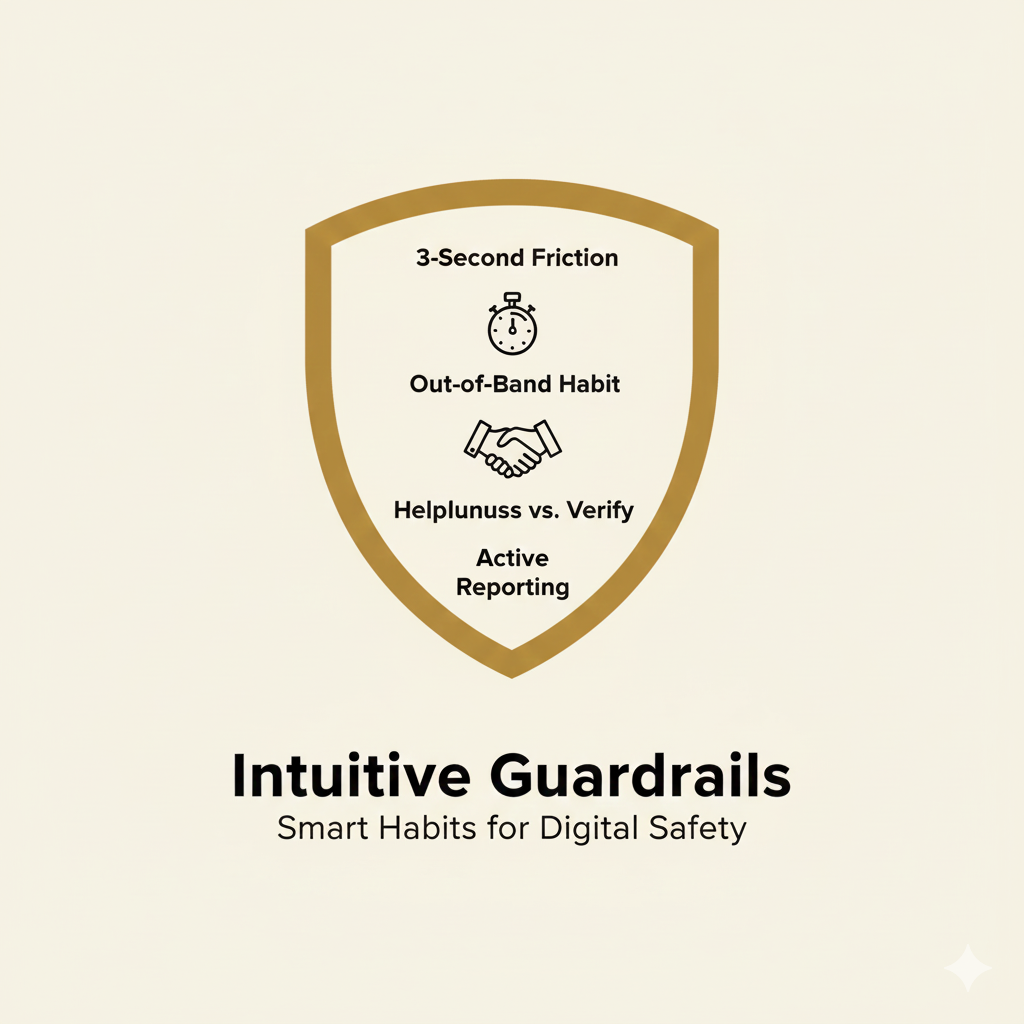
The '3-Second Friction' Rule: I teach your team how to identify "High-Stakes Moments" like changing bank details or sharing sensitive credentials and apply exactly three seconds of mental friction. It’s not a process; it’s a reflex.
The 'Out-of-Band' Habit: I teach your team how to "cross-check" identity without it feeling like an interrogation. If a request comes in via Slack, they verify via voice. If it comes via email, they verify via a quick video check.
The 'Helpfulness vs. Verification' Balance: Small teams are helpful by nature. I train your staff to understand that Verification IS a form of Helpfulness. By double-checking a weird request, they aren't being "difficult", they are protecting the colleague they think they are talking to.
The 'Active Reporting' Muscle: In a slow company, a mistake is hidden for weeks. In an agile and trained team, an accidental click is reported in seconds. I help you build a "No-Blame" culture where your team becomes your fastest detection system.
You don't need to slow down. You just need to know how to spot the digital 'rattle of the door handle' while you're moving.
To learn a few concrete steps you can take today to increase your team’s vigilance and build lasting security habits, book a free 15 minute call with me!
*While the 350% statistic was a landmark finding in the early 2020s, the emergence of Agentic AI in 2026 has only accelerated this trend, making every 'digital door-rattle' more personalized and harder to ignore.